


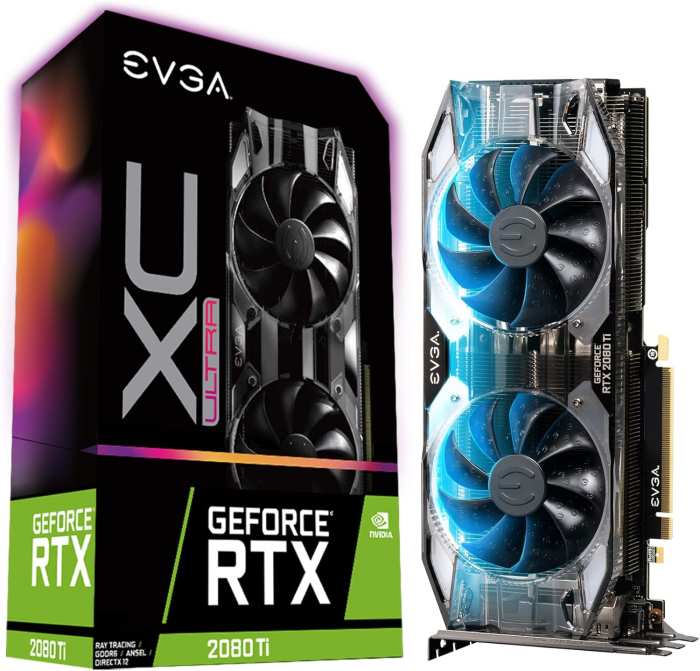
EVGA GeForce RTX 2080Ti XC
Overview
The EVGA GeForce RTX 2080 Ti XC is a high-performance graphics card built on NVIDIA's Turing architecture. It delivers exceptional 4K gaming performance and is a solid choice for content creators, streamers, and enthusiasts who demand top-tier frame rates and advanced features like real-time ray tracing and DLSS.
Who Is It For?
This GPU targets gamers who want to play at 4K resolution with high settings, as well as professionals working with 3D rendering, video editing, or AI workloads. It's also a great option for VR enthusiasts and those building a high-end gaming rig.
Key Features
- Memory Buffer: 11GB GDDR6 with 352-bit interface for smooth multitasking and high-resolution textures.
- CUDA Cores: 4352 shading units for massive parallel processing power.
- Ray Tracing & DLSS: Dedicated RT and Tensor cores enable real-time ray tracing and AI-enhanced performance.
- Connectivity: HDMI 2.1, DisplayPort 1.4a, and USB-C for VR and next-gen displays.
- Compact Design: 269mm length fits most mid-tower cases, with dual fans for efficient cooling.
Performance Highlights
In gaming benchmarks, the RTX 2080 Ti XC consistently achieves 60+ FPS in AAA titles at 4K Ultra settings. It also excels in creative applications like Adobe Premiere Pro and Blender, thanks to its high CUDA core count and 11GB VRAM. The 250W TDP requires a 600W PSU, making it suitable for most high-end builds.
Use Cases
Whether you're a competitive gamer, a 4K enthusiast, or a professional creator, this card handles it all. It supports multiple monitors, VR headsets, and can even handle machine learning experiments with Tensor cores.
Overall, the EVGA GeForce RTX 2080 Ti XC remains a powerful option for those seeking high-end performance without the latest-gen price tag.
Key Specifications
Detailed Parameters
- TDP in Watts:
- 250
- Minimum PSU Wattage Supported:
- 600
- Length in mm:
- 269
Pros
- Excellent 4K gaming performance
- 11GB GDDR6 VRAM for future-proofing
- Supports ray tracing and DLSS
- Compact size fits most cases
- Multiple display outputs including USB-C
Cons
- High power consumption (250W TDP)
- Requires 600W PSU minimum
- Older architecture compared to RTX 30/40 series