


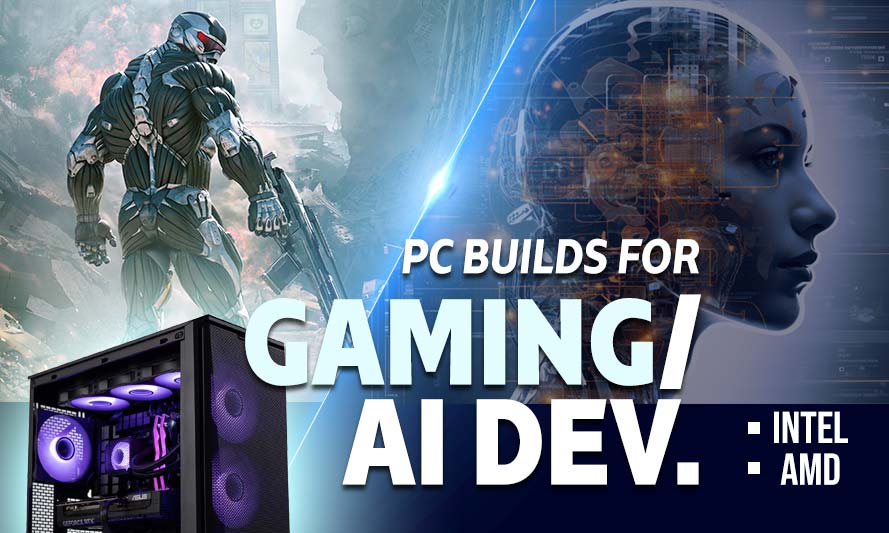
The question keeps surfacing in builder communities: can a single machine handle 4K gaming on a Friday evening and then crunch neural network training on a Saturday morning without either task suffering? In 2026, the answer is yes – provided the right components are paired together. Building the most affordable AI workstation for gaming and development is less about throwing money at the problem than understanding where performance leverage actually lives. Most builders overspend on the wrong parts and then wonder why their render times still crawl. This guide walks through complete Intel and AMD builds across three price tiers – budget, mid-range, and high-end – so you can find the configuration that fits your workload and your wallet.
Why Dual-Purpose Builds Are Worth the Effort in 2026
The old advice was to keep workstations and gaming rigs separate. That position has not aged well. Modern GPUs from both NVIDIA and AMD now carry enough VRAM and compute throughput to serve both workloads without obvious compromise. The CPU landscape has matured similarly; a single processor can manage game physics, AI inference, and code compilation without becoming the bottleneck.
The challenge is budget allocation, not capability. Spend too much on the CPU and the GPU budget suffers; skimp on RAM and AI workflows will page-fault constantly. The builds in this guide are structured to avoid those traps at each price point.
What Makes a Machine Qualify as an Affordable AI Workstation for Gaming and Development?
Not every gaming PC functions as an AI workstation, and not every workstation can game. The qualifying criteria for the builds here are specific: a minimum of 16GB VRAM on the primary GPU (necessary for running local LLMs and diffusion models at practical speeds); at least 32GB of system RAM expandable to 64GB or beyond; NVMe storage with strong sequential read speeds for fast dataset loading; a CPU with solid single-thread performance for gaming and adequate multi-thread throughput for compilation and preprocessing; motherboard support for PCIe 5.0 to accommodate future GPU and storage upgrades; and sufficient thermal headroom to sustain all-core loads during extended training runs. If a build satisfies those criteria while staying within a reasonable price ceiling, it earns its place on this list.
Intel Builds for AI Workstation for Gaming and Development
These components are hand-picked and vetted for compatibility, though we do not guarantee availability. They are suitable for a high-performance Intel-based desktop build for AI workloads and gaming, across 3 budget categories. If you prefer different components, you can swap out any part using the AI PC Builder tool. Simply click the BUILD/CUSTOMIZE THIS button to get started.
Budget Tier Intel-Based AI Workstation for Gaming and Development
- CPU: Core i5-14600K$249.97
Price on Newegg
Amazon Price
- Motherboard: MSI Pro Z790-A Max WiFi ProSeries$109.99
- GPU: MSI GeForce RTX 4070 Ventus 2X OC $1,145.00
- RAM: Corsair Vengeance DDR5 RAM 32GB$549.99
- Storage 1: Crucial T710 1TB Gen5 NVMe SSD$279.75
- PSU: Cooler Master MWE Gold Full Modular 80+ Gold 750W$104.03
- Case: Fractal Design Pop Air RGB$97.27
- CPU Cooler: Cooler Master Hyper 212$35.98
- Storage 2: Seagate Barracuda 8TB$279.99
TOTAL COST: $2,851.97
📊 Price History
[Prices updated: 5:22pm, 10/27/2026]
Mid-Range Tier Intel-Based AI Workstation for Gaming and Development
- CPU: Core i7-14700K$379.00
- Motherboard: ASUS ROG Strix Z790-E Gaming WiFi II$888.51
- GPU: ASUS TUF Gaming GeForce RTX 4070 Ti Super OC (Unavailable)$999.99
- RAM: G.Skill Ripjaws S5 Series DDR5 RAM 64GB$1,099.99
- Storage 1: Crucial T710 2TB Gen5 NVMe SSD$419.00
- Storage 2: Toshiba X300 Pro 10TB (Unavailable)$499.99
- PSU: MSI Mag A850GL Full Modular 80+ Gold 850W$109.99
- Case: Lian Li Lancool 216 Mid-Tower Case$127.15
- CPU Cooler: Noctua NH-D15 chromax Black$119.95
TOTAL COST: $4,643.57
📊 Price History
[Prices updated: 5:22pm, 10/27/2026]
High-End Tier Intel-Based AI Workstation for Gaming and Development
- CPU: Core i9-14900K$449.00
- Motherboard: ASUS ROG Maximus Z790 Hero$499.99
- GPU: Gigabyte GeForce RTX 4090 Gaming OC (Unavailable)$2,699.99
- RAM: G.SKILL Trident Z5 Royal Neo Series 96GB DDR5 RAM (Gold) $2,209.99
- Storage 1: Samsung 9100 Pro NVMe PCIe 5 2TB $412.99
- Storage 2: Toshiba X300 Pro 10TB (Unavailable)$499.99
- PSU: Corsair HX1000i 1000W 80+ Platinum Fully Modular$231.99
- Case: Fractal Design Torrent RGB Black ATX Airflow Mid Tower (Unavailable)$223.55
- CPU Cooler: NZXT Kraken 360 RGB 360mm AIO CPU Liquid Cooler$253.47
TOTAL COST: $7,480.96
📊 Price History
[Prices updated: 5:22pm, 10/27/2026]
AMD Builds for AI Workstation for Gaming and Development
These components are hand-picked and vetted for compatibility, though we do not guarantee availability. They are suitable for a high-performance AMD-based desktop build for AI workloads and gaming, across 3 budget categories. If you prefer different components, you can swap out any part using the AI PC Builder tool. Simply click the BUILD/CUSTOMIZE THIS button to get started.
Budget Tier AMD-Based AI Workstation for Gaming and Development
- CPU: Ryzen 5 7600X$163.69
- Motherboard: MSI MAG X670E Tomahawk WiFi$395.00
- GPU: ASUS Dual GeForce RTX 4070 EVO OC Edition$799.99
- RAM: Patriot Viper Elite 5 32GB DDR5$477.99
- Storage 1: Crucial T710 1TB Gen5 NVMe SSD$279.75
- Storage 2: Seagate Barracuda 8TB$279.99
- PSU: Corsair RM750e 80+ Gold Fully Modular$89.99
- Case: Fractal Design Pop Air RGB$97.27
- CPU Cooler: Cooler Master Hyper 212$35.98
TOTAL COST: $2,619.65
📊 Price History
[Prices updated: 5:22pm, 10/27/2026]
Mid-Range Tier AMD-Based AI Workstation for Gaming and Development
- CPU: Ryzen 7 7800X3D$348.00
- Motherboard: ASUS TUF Gaming X670E-Plus WiFi$119.99
- GPU: ASUS TUF Gaming GeForce RTX 4070 Ti Super OC$1,699.00
- RAM: G.Skill Ripjaws S5 Series DDR5 RAM 64GB$1,099.99
- Storage 1: Crucial T710 2TB Gen5 NVMe SSD$419.00
- Storage 2: Seagate Barracuda 8TB$279.99
- PSU: MSI Mag A850GL Full Modular 80+ Gold 850W$109.99
- Case: Lian Li Lancool 216 Mid-Tower Case$127.15
- CPU Cooler: Noctua NH-U12S chromax Black$99.95
TOTAL COST: $4,303.06
📊 Price History
[Prices updated: 5:22pm, 10/27/2026]
High-End Tier AMD-Based AI Workstation for Gaming and Development
- CPU: Ryzen 9 9950X$539.00
- Motherboard: ASUS ROG Crosshair X670E Hero$835.46
- GPU: Gigabyte GeForce RTX 4090 Gaming OC (Unavailable)$2,699.99
- RAM: G.SKILL Trident Z5 Royal Neo Series 96GB DDR5 RAM (Gold) $2,209.99
- Storage 1: Samsung 9100 Pro NVMe PCIe 5 2TB $412.99
- Storage 2: Toshiba X300 Pro 10TB (Unavailable)$499.99
- PSU: Corsair HX1000i 1000W 80+ Platinum Fully Modular$231.99
- Case: Fractal Design Torrent RGB Black ATX Airflow Mid Tower (Unavailable)$223.55
- CPU Cooler: NZXT Kraken 360 RGB 360mm AIO CPU Liquid Cooler$253.47
TOTAL COST: $7,906.43
📊 Price History
[Prices updated: 5:22pm, 10/27/2026]
Installation and Setting Up
With a parts list confirmed, physical assembly is the next step. The order of operations matters: install the CPU and cooler on the motherboard outside the case first, then seat the RAM, and slot in the M.2 drive before the board goes into the chassis. Connect PSU cables before installing the GPU, since the RTX 4090 in particular occupies enough real estate to make cable management awkward if left until last.
For software, start with a clean Windows 11 installation or a Linux distribution such as Ubuntu 22.04 LTS if your AI workloads lean toward PyTorch and CUDA toolchains. Install GPU drivers before any CUDA toolkit or ML framework to avoid version conflicts. Verify that the NVMe drive is recognised at its rated speed in the BIOS before loading the operating system.
If you prefer a guided walkthrough for the physical build, this step-by-step DIY PC build guide covers the full process from unboxing to first boot.
Optimizations for Your Use Case
Once the system is running, a few targeted adjustments can meaningfully close the gap between a general-purpose desktop and a proper AI development and gaming machine.
For AI workloads: Enable XMP or EXPO in the BIOS to ensure the RAM runs at its rated speed; DDR5 ships at JEDEC defaults that leave bandwidth on the table. In PyTorch, set torch.backends.cudnn.benchmark = True for inference workloads with consistent input sizes. If you are running local LLMs through a tool like LM Studio, configure the GPU offload layer count to match your VRAM ceiling and monitor VRAM usage with nvidia-smi during initial runs.
For gaming: Enable Resizable BAR in the BIOS – it is supported on all the motherboards listed here and typically yields 5-10% frame rate improvement in GPU-limited scenarios. On the Ryzen 7 7800X3D specifically, disable Precision Boost Overdrive; the 3D V-Cache architecture performs better under its stock frequency management in games. Undervolting the GPU using MSI Afterburner reduces temperatures during extended gaming sessions without meaningful frame rate loss, which matters when the same GPU will handle training runs the following morning.
Thermal management: Both the Fractal Torrent and Lancool 216 cases are selected for airflow. Run the system under a sustained AI workload for at least an hour and log CPU and GPU temperatures. If either exceeds 90°C under load, adjust fan curves in the BIOS or through the motherboard’s software before committing to overnight training jobs.
Concluding Thoughts
A decent AI workstation for gaming and development is no longer the exclusive territory of six-figure lab budgets or enterprise procurement. The builds above – covering both Intel and AMD platforms across budget, mid-range, and high-end tiers, demonstrate that the dual-purpose machine is a practical target for builders willing to allocate components deliberately. The GPU carries the heaviest weight in this configuration type; the rest of the build exists largely to keep it fed and cool. Wherever you land on the price spectrum, prioritise VRAM headroom over everything else and you will rarely regret the trade-offs.
All Articles