


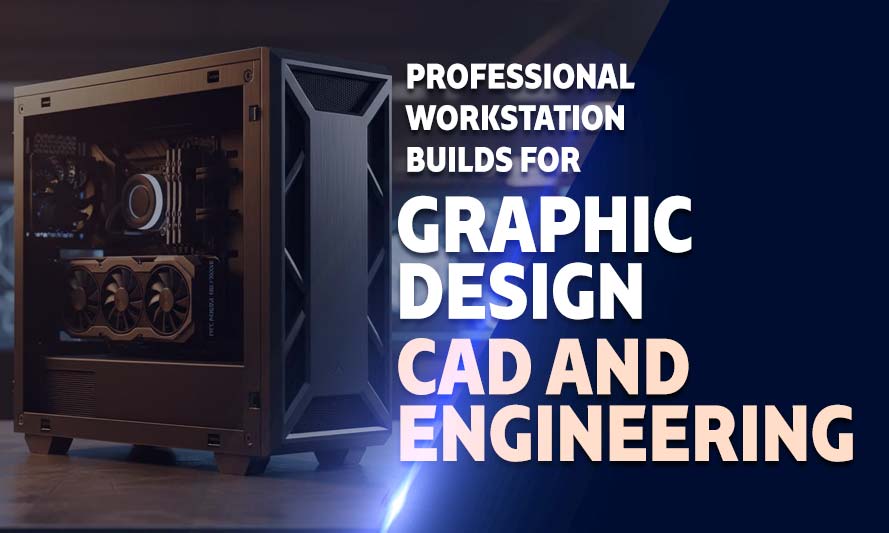
If your workstation is still struggling to render a 3D model while your coffee goes cold, this guide was written specifically for you. The top professional workstations for graphic design, CAD, and engineering in 2026 have crossed a threshold where the gap between “good enough” and “genuinely fast” is wider than ever, and picking the wrong rig means paying full price for half the performance. Whether you’re extruding solids in SolidWorks, compositing 8K footage in DaVinci Resolve, or pushing polygon counts in Blender, the machine underneath you either keeps up or it doesn’t. There’s no middle ground at this level.
This guide breaks down what actually matters for professional creative and engineering workloads in 2026, recommends specific components, and helps you avoid the usual traps that cost people money and time. Gamers who moonlight as designers, welcome too; a lot of this overlaps more than you’d think.
What Makes a Workstation Different from a Gaming PC?
A gaming PC and a professional workstation can share the same chassis, the same GPU brand, even the same CPU socket, but they’re tuned for fundamentally different jobs. Gaming prioritizes frame rates, low latency, and raw GPU throughput at consumer-grade precision. A workstation prioritizes sustained multi-threaded performance, memory bandwidth, ECC RAM support, and software-certified drivers.
CAD and engineering software like AutoCAD, CATIA, and ANSYS often run better on a mid-range Quadro or Radeon Pro GPU than on a flagship gaming card, purely because of driver certification. Graphic design workloads in Photoshop and Illustrator are more CPU and RAM dependent than most people realize. Knowing this before you spend anything is worth more than any single component recommendation.
Key Components to Prioritize in 2026 Professional Workstations
CPU: Core Count vs. Clock Speed
For graphic design, a high single-core clock speed matters more than raw core count. Photoshop, InDesign, and most Adobe apps are still not fully multi-threaded. For CAD and engineering simulation, the opposite is true; ANSYS Fluent, for instance, scales across every core you give it.
In 2026, the AMD Ryzen Threadripper Pro 7000 series and Intel Xeon W-3500 series remain the ceiling for professional desktop workloads. For mid-range builds, the AMD Ryzen 9 9950X and Intel Core Ultra 9 285K offer strong single-core performance with enough multi-threaded headroom for most design and moderate CAD tasks.
RAM: Capacity and Speed
64GB DDR5 is the practical minimum for serious workstation builds in 2026. Large assemblies in CATIA or SolidWorks will exhaust 32GB faster than you’d expect, and Blender renders with complex scenes can do the same. If your budget allows, 128GB positions you comfortably for the next several years.
ECC RAM is worth pursuing if your platform supports it; it catches single-bit memory errors silently, which matters when a simulation runs for six hours and you’d rather not lose the output to a random bit flip. AMD’s Threadripper Pro platform supports ECC natively, which is one reason it dominates high-end creative and engineering studios.
GPU: Certified vs. Consumer
NVIDIA RTX 4000 Ada Generation and AMD Radeon Pro W7800 are the workhorses of certified professional graphics in 2026. They’re expensive, but for software that requires ISV certification (SolidWorks, CATIA, Revit), they’re the responsible choice. Consumer cards like the RTX 4090 can handle these applications, but you may encounter driver instability or unsupported features at inconvenient moments.
For graphic designers who don’t touch CAD, a high-end consumer GPU like the RTX 5080 is perfectly reasonable and significantly cheaper per VRAM gigabyte than its professional equivalents.
Storage: NVMe Speed and Capacity
A Gen 5 NVMe SSD as your primary drive is no longer a luxury in 2026; it’s the baseline for anyone working with large project files, 4K or 8K media, or complex CAD assemblies. Samsung 990 Pro, WD Black SN850X, and Seagate FireCuda 540 are all solid picks depending on your motherboard’s available slots.
Secondary storage for project archives and backups should be a high-capacity HDD or a secondary SSD. If you’ve ever had an external drive go sideways on you mid-project, the guide on recovering a corrupted external hard drive without formatting is something to bookmark now, before you need it.
Top Professional Workstations for Graphic Design, CAD And Engineering: Recommended Builds
Before diving into the component lists below, consider using the AI PC Builder tool to generate a build tailored to your specific use case. It works for beginners who just need a starting point and for experienced builders who want to swap parts and check compatibility on the fly. Click the BUILD/CUSTOMIZE THIS button on any build to start configuring it to your exact needs.
Recommended Components for a Mid-Range Graphic Design Workstation
These components are hand-picked and vetted for compatibility, though availability may vary. They are suitable for an AMD-based workstation build optimized for graphic design, video editing, and general creative workloads. If any recommendation doesn’t fit your budget or preference, you can swap parts freely using the AI PC Builder tool. Simply click the BUILD/CUSTOMIZE THIS button to get started.
- CPU: Ryzen 9 9900X$327.00
Price on Newegg
Amazon Price
- Motherboard: ASUS ProArt X870E Creator WiFi$546.49
- GPU: PNY GeForce RTX 5080 Triple Fan$1,199.99
- RAM: G.SKILL Flare X5 Series DDR5 RAM 32GB$469.99
- Storage 1: Inland TN470 SSD 2TB Gen4 NVMe$309.99
- Storage 2: Seagate IronWolf 8TB NAS HDD$297.78
- PSU: Golden Field 1050W Power Supply Cybernetics Platinum Fully Modular$89.99
- Case: Air Cross Genuine Walnut Wood ATX Case $86.99
- CPU Cooler: Thermalright Phantom Spirit 120 EVO CPU Cooler$42.21
TOTAL COST: $3,370.43
📊 Price History
[Prices updated: 5:50am, 07/27/2026]
Recommended Components for a High-End CAD and Engineering Workstation
These components are hand-picked and vetted for compatibility, though availability may vary. This is a high-end AMD Threadripper Pro-based build suited for demanding CAD assemblies, FEA simulation, and computational fluid dynamics. If the build needs adjusting for your budget or software environment, use the AI PC Builder tool and click BUILD/CUSTOMIZE THIS to modify it.
- CPU: Ryzen Threadripper Pro 7965WX$2,837.99
- Motherboard: ASUS Pro WS TRX50-Sage$849.99
- GPU: PNY Quadro RTX 6000$1,199.96
- RAM: Nemix 128GB Registered Server Workstation RAM$4,798.99
- Storage 1: Samsung 9100 Pro NVMe PCIe 5 4TB $898.00
- Storage 2: Seagate IronWolf Pro 16TB Enterprise NAS$691.45
- PSU: be quiet! Dark Power Pro 13 1300W$429.90
- Case: be quiet! Dark Base Pro 900 (Unavailable)$119.90
- CPU Cooler: Noctua NH-U14S TR5-SP6 Premium Cooler$139.95
TOTAL COST: $11,966.13
📊 Price History
[Prices updated: 5:50am, 07/27/2026]
Practical Tips for Getting the Most from Your Workstation
Keep the System Clean, Literally and Digitally
A workstation running at thermal limits due to dust buildup will throttle its CPU and GPU regardless of how much you spent on the hardware. Clean your system every three to four months, especially if it sits on the floor. On the software side, bloat accumulates faster than most people notice, and it eats into the performance margin you paid for. The guide on cleaning up your computer to make it run faster covers both the physical and software sides of this in practical detail.
Match Your Monitor to Your Work
A professional workstation paired with a poorly calibrated consumer monitor is a genuine waste of investment for anyone doing color-critical work. For graphic design, an IPS or OLED panel with at least 99% sRGB and ideally 95% DCI-P3 coverage is the minimum worth considering. BenQ SW321C and ASUS ProArt PA32UCX-PK are both well-regarded in professional creative circles.
For CAD and engineering, color accuracy matters less than resolution and screen real estate. A 4K 32-inch display gives you the pixel density to work with complex technical drawings without zooming constantly.
Don’t Overlook Cooling and Airflow
Threadripper Pro and high-core-count Xeon CPUs generate serious heat under sustained load. A 360mm AIO or high-end air cooler isn’t optional here; it’s the difference between a workstation that sustains peak performance and one that quietly throttles itself after twenty minutes of simulation. Front intake, rear and top exhaust is the standard airflow configuration that holds up in almost every case design.
Final Thoughts
Building or buying one of the recommended top professional workstations for graphic design, CAD, and engineering in 2026 is a deliberate process, not a shopping spree. The hardware ceiling is extraordinarily high right now, but the practical ceiling for most workflows is much lower, which means overspending is just as common a mistake as underspending.
Match the build to the software, verify driver certification where it matters, and don’t let marketing language substitute for benchmark data. Use the AI PC Builder tool to cross-check compatibility and explore alternatives within your budget. The BUILD/CUSTOMIZE THIS button is there precisely because no two workflows are identical, and neither should two workstation builds be.
All Articles
This guide really helped me pick between AMD and Intel budget builds. Didn’t realize GPU price mattered this much until I read this. Going with AMD Budget build. Thank you!
Good to know you found it helpful.
Hardware encoding through NVENC cutting export time dramatically without taxing the CPU simultaneously is the efficiency gain most editors appreciate most. Found some solid options for professional GPU rendering over at Orange Hardwares dot com… worth checking before deciding.